
Bynum that's so cool! You should post pictures of it here!
Forum Activity for @strumelia

I think Susan Trump has a fretless banjo made by Stanley Hicks, and i believe she knew him personally. You coudl try to contact her via her website.
Nina
updated by @nina-zanetti: 02/17/16 04:09:30AM
Hi Cindi - type of strings has nothing to do with make or tone of dulcimer. You need to know the VSL(25", 27", 29") and the keynote you want to tune to (C, D,G etc), Buy dulcimer strings unless you can't find them, In general any set of strings with .010 to .012 melody and middle drones and a .020 to .024 wound bass string will do just fine for most average VSLs and tunings.
Playing in a Jam....
Playing and jamming difficulties...HELP ME!
I actually went to a concert of Aubrey and Elwood's a couple of weeks ago (very fortunate that they were playing only 30 minutes away!) and I bought yet another limberjack from her for my limberjack 'collection' of about a dozen.
They are such fun... especially when everyone at the jam is playing in a key that you don't want to touch with a ten foot pole!....lol! Just take out yer little dancing man and watch the fun begin. 

Playing in a Jam....
Playing and jamming difficulties...HELP ME!
Thanks Wayne. I have seen Aubrey Atwater play one a couple of times, but didn't know what it was called.
Ben
Playing in a Jam....
Playing and jamming difficulties...HELP ME!
Once again, thanks to all of your replies...it really helps, although, it's going to take this musically challenged dulcimer player a while to learn some of the valuable information that you have provided.
I have discovered that part of my problem is that I am playing in a country jam and they tend to play in a particular rhythm that throws me totally off. I go up to take my turn and even though I know my song well, I hear their rhythm and I can't shake it out of my head.
I did have the good fortune to play this past week and it did happen yet once again. But a gentleman who has often encountered the same thing recognized that it was happening to me while I was playing "Blowin' in the Wind" and he came to within earshot of me and got me into the right rhythm with his mandolin.
I will have to display my ignorance here Strumelia as I haven't heard of a "limberjack".
Playing in a Jam....
Playing and jamming difficulties...HELP ME!
Ben, it's challenging to play in a large group with lots of different instruments, especially when there are singer-songwriter guitar players singing songs in different keys every time. Diane had some particularly useful advice I think.
I play more often in old-time fiddle jams with banjos and that makes a big difference- they stay in one key for a good half hour or an hour or sometimes even longer. That gives plenty of time to retune when a key change is announced. Even then, i like to bring two dulcimers- one for C and D, the other for G and A. They fit in a double dulcimer gigbag.
Occasionally we go to places where I know it's going to be really difficult for me to play along, for one reason or another. That's when I bring a limberjack and it's always fun to 'play' ...and just about everyone likes limberjacks.

Playing in a Jam....
Playing and jamming difficulties...HELP ME!
Benjamin,
If you happen to have a dulcimer with a 6-1/2 fret, you can tune the strings all to D-- either Ddd or go with all light strings and tune ddd-- and you're set for the key of D (tonic open) and the key of G (tonic at 3) without re-tuning.
Some tuners that clip on work well in a noisy setting.
Playing in a Jam....
Playing and jamming difficulties...HELP ME!
Perhaps the one thing that I failed to mention is that in this particular setting, it would be nigh impossible for me to change my tuning as there is too much noise (well, music and sound is probably a better description) going on and my tuner won't know what to tune the strings to.
Playing in a Jam....
Playing and jamming difficulties...HELP ME!
Benjamin,
My main dulcimer has no 6-1/2 fret. I use DAA as my home base tuning. For A tunes, I put a false nut under the bass string at the first fret-- a quick way to change tuning to EAA. For G tunes, I go to DGG. Some tunes won't lay-out right in these tunings, so I can either sit them out or just play some basic back-up rhythms.
Playing in a Jam....
Playing and jamming difficulties...HELP ME!
Thanks to all of you who have responded to my question. It is helpful. The particular dulcimer that I have been bringing to the jam doesn't have the 6 1/2 fret. I bring this one for two reasons: It is the one that I seem to play the most (my first one) and it has a case. I like your responses and will have to see if I can improve my playing in the jam while experimenting with your suggestions. Thanks again. Ben
Playing in a Jam....
Playing and jamming difficulties...HELP ME!
Benjamin,
You can play rhythm when playing back-up. I love to do this in a jam! And it's fun to get creative with rhythms. Since the dulcimer isn't loud, you can experiment. . .
Playing in a Jam....
Playing and jamming difficulties...HELP ME!
Yes Dana, but you would also be in different modes by using a capo- you'd be in E minor with the capo on 1, and you'd be in A Dorian (another minor-sounding mode) if you capo on 4. So if the jam is playing in the 'normal' key of A (not in A minor for example), you can't just slap a capo on the 4th fret and play along in A- you'd sound too minor, your fret pattern would be laid out for Dorian mode there at the 4th fret. Same thing happens when you put the capo on fret 1 for key of E- it will be E aeolian, a minor sound. That may clash badly with (chromatic) guitar players capoed to E and playing in a major sound.
The capo solution works well for going to G by capoing DAd on the 3rd fret- only because you were likely playing in ionian from DAd anyway, by using the 6.5 fret for most tunes. Placing the capo on 3 again produces the ionian mode, for G. So there is no noticeable mode change in that instance.
Playing in a Jam....
Playing and jamming difficulties...HELP ME!
You can use a capo and capo on the 3rd fret and you would be playing in the key of G capo on 4th fret and you are playing in A. capo on the 1st fret and your in the key of E If i'm wrong someone correct me please.
Playing in a Jam....
Playing and jamming difficulties...HELP ME!
I have been playing in a jam session which happens on an every other week venue. Most of the participants play the guitar, a couple may play a harmonica, one plays drums, maybe a mandolin and a fiddle or two. All play and one at a time each one gets to the microphone to do his or her song while the group plays back up.
The question is always, "what key are you playing in?" Responses will vary, but Key of G, D or A, etc. Seldom is the title of the song given, but sometimes it is.
I take my turn and say what key (usually D) and tell them the song.
I guess, the question that I have is how does one play the Key of A, for example, and often not even know the song until it is started by the performer?
And what do I do or play when I'm playing back up? Not that I'm heard over 20-30 instruments....
updated by @benjamin-w-barr-jr: 01/17/16 07:19:42AM

I guess the mood is in the ear of the listener, as I do hear a change. As I hear a mood change in the following from the first part "Erev Shel Shoshanim" which is a lyrical love song frequently sung at weddings, to the joy of "Siman Tov and Mazel Tov" a song frequently done at the end of the wedding ceremony.
But the music I have for them both in Aeolian with minor chords with the sheet music for "Simon Tov" instructing it to be played "Joyously" as it is.
But as I said, it's probably in the ear more than the music as "Shady Grove" strikes me as quite a happy, bouncy tune too.
I don't hear the mood change, the fast section is every bit as brooding as the slow section. Perhaps the lyric is gay and carefree, I have no idea there,but the music doesn't reflect gaiety. A faster tempo cannot always be equated with a lighter mood. Contrast the Storm and the Pastorale sections from The William Tell Overture. This is not the full overture, but it begins with The Storm, continues with The Pastorale, and concludes with the triumphant Finale. The Storm starts slower, but builds tension as it speeds up, while the slow Pastorale is light and happy. This is done partly with the mood of the different mode used, and also with the chord progressions used to harmonize each section. But bear in mind that the chords are tied to the mode used-the location of the half steps that creates each mode dictates the chords that come from each mode. Dad had a recording of William Tell, and I grew up with it. Uncle Carl had a very different arrangement of it: As a kid, I liked them both, but Spike probably had the upper hand at that time.
Paul
Pop, What frets are you using to play the second verse? I can't figure it out just hearing it. There is enough of Amazing Grace left that to me it's not entirely a new tune, but rather it sounds simply as if you are miss hitting some of the frets correctly. This is especially true when hearing the verses together, if you hadn't played the first and last verse, I'd probably be trying to put words to the tune and sing it, but not able to do so. But this frequently happens to me when someone is playing a tune that I know as a song, and has added a great deal of ornamentation and embellishment to the original melody.
Paul, Here's an example of what I meant by a mode not necessarily a emotion such as happy, sad, light, dark. This is Shlomo Carlebach's song "Am Yisrael Chai", it is in the Aeolian mode and is in C minor, key signature with 3 flats and ending on a C or 1 (to me) and Cm is the final chord. I'm looking at Sholmo's musical notation for it and I can't say hearing it played what key he is actually doing it in. You can hear the mode start out slowly and perhaps you can say somberly at first, but about 1:14 the mood changes as the tempo changes. This happier mood is how most people sing and dance the tune.
Centuries of doing wrong may make it common, but not necessarily correct. Sir Elton can only speak for himself, Chuck Berry sued The Beatles for using certain lines in Come Together. Speed and rhythm do not set mood nearly as much as the use of certain modes does. A part of the problem is the use of extra frets and capoes on dulcimers. I have seen too many people who fail to understand the characteristics of different modes partly because a few extra frets allows more than one mode to be played from a single tuning. Similarly, by moving a capo around all the modes are possible in one tuning. But each new position of the capo causes us to lose notes we played in the same tuning with different capo positions, or no capo at all. Not understanding the mode clouds the issue, we can't necessarily play the same song in different modal scales. Each mode has slightly different notes available. At the same time, for chord players,the notes available in a mode dictate what chords can be made using that modal scale. The harmonic elements of a mode are implied by the notes available, and by the locations of the half steps in that mode. This holds true whether we play chords or drones.Playing a diatonic instrument makes this very evident. Adding a capo or extra frets makes this much less easily seen. But when we take out notes from the melody, and substitute notes the composer didn't choose to use, we alter it into a new melody. ( I have done this myself, while singing, but only because I can't carry a tune in a bucket!) We do change the mood of the piece by changing the mode. Faster or slower is a change of arrangement. Using a rock setting rather than a country or jazz setting is a change of arrangement. Taking an ionian tune, and "playing" it using the lydian scale is not an arrangement, it's a new tune. If you use a new tune, for the sake of truth, say you have written a new tune. Anything less is bait and switch. Sir Elton may not mind if you put his words for Candle In The Wind to the tune from Ode To Joy, but if you can't get permission from Beethoven, maybe out of respect you should not go there. I'm not a composer, you won't find any songs of mine any where. I merely stated an opinion, based on not confusing other people who wonder why different peoples versions of the same song sound so different.
Paul
There was a discussion awhile back about the moods of the modes. I say again basically what I said then. A mood can be created by a strong rhythm and beat, more than a mode creates a mood.
I know some dance tunes that are in Aeolian and when I can get them up to speed they are rollicking. The Massacre at Glencoe, on the other hand, is a very serious and somber song written in Ionian and it make me cry.
Arrangements are one thing, re composing a song in another mode is quite another. The chords implied in the drones are not the same when we change modes. The moods are different, sometimes vastly so. The lightness of the ionian mode is very unlike the somber feel of aeolian, though only one note is different. If you take all the major thirds out of the tune, and replace them with minor thirds, you change the feel of the composition. We often use a minor ii chord in place of a major IV chord, this is a change of arrangement. We still resolve to the same I chord at the end. But we don't change the melody. Changing the mode is akin to a new composition, as you may find the original resolution chord is not available in a different mode. Confusion about modes is common, it isn't the simplest subject in harmony studies. The bottom line is we can't always find all the necessary notes for a given tune in multiple modes.
Paul
While everyone is certainly welcomed to their personal opinion, and may I say that indeed as many of us as are on here, that could be a lot of opinions, I would have to paraphrase something that I heard Elton John say in regards to a compilation of songs that he wrote that were interpreted by other artists: That it would be okay with him. After all, each one has a different take on a song and it makes it theirs to do with whatever, be it country-western, pop, jazz or even rap. His song was still his song and he admired those who did make another interpretation as an artist. You can hear that on his Two Rooms CD, in songs such asThe Bitch is Back andPhiladelphia Freedom.
Paul, Changing modes has been a trick that musicians have used for centuries. An example of this is Barb'ry Ellen as it's been change in the mountain singing. Jean Ritchie plays it in the Aeolian mode, but I used English not American songbooks to tab my version of it out. So my version is titled "Barbara Allen" and is in the Ionian mode.
This modal change that has been done, seems to me quite common.
I've got "Barbara Allen" stuck in my mind and realized that I'd phrased that last sentence to fit the final measures of the tune. 9-10-8-6-7-8-3,4-5-7-8-7-5-3 Now I'll have to go play something else to get it out of my mind. heheheheeeee
CAUTION! PERSONAL OPINION: If I wrote a song, and someone changed the mode, I would ask them to stop playing it, and to please leave my compositions alone in the future. If you don't like my peaches, don't shake my tree. Changing the mode changes the mood of the piece, it is not the same as it was composed. But that is only an opinion.
Paul
Pop,
I should have mentioned that, although the melody sounds correct, the drones won't as the melody isn't in the key of G. If you play tuned DGC starting with the g at 4, with my tab the doh note of the scale is actually starting at the 7th fret or the C. Your drones should be a C and G not D and G.
All that is happening is that the 4th fret is standing in place of the nut for the start of the fret placement pattern.If your dulcimer has a 6+ and 13+ frets, for an Ionian scale as "Amazing Grace" uses, you skip the 6th fret and use the 6+ for your second whole step with the 7th fret the first half step. After that up the fretboard the 10th fret is the second 1/2 step and would be played like the traditional 6th fret. There is no 10+ so no 6+ on the nut at 4 playing pattern. If you have a 13+ that becomes the 9th fret and 14 is now the 10th fret. My dulcimers go up to the 16th fret so I could play Ionian tunes that go up to the 12th fret, but no higher when starting at 4.
No problems, Pop.
Assuming thatafter you re-tune you are "playing the same song" by playing the same fret numbers on the melody string(s), then it is the same tune, but not in the same key or Modal tuning. All you've done is change the scale from one starting at G (the GDD tuning) to one that starts at F (the DGC tuning). Because the drones are not identical (same notes but different octaves and string types) in the two tunings you certainly will get a different sound, but not a different tune. If you ignore the drones the two tunes are the same, just in different keys.
Shady Grove can be played in a Dorian tuning as it doesn't use a 6th fret.
In the book "Tunes of the Wilderness Road" by Smith and MacNeil Shady Grove is tabbed out twice once using DAC for a tuning arranged for the Aeolian Scale, and once tuned DAG written for Dorian. The first one give the Standard Musical Notation as written in the key of F ending on D or a 1. The second give the SMN as the key of C with the music ending on D or a 4th fret.
No, even a key change which is done quite a bit doesn't change the song to another song. I have lots of song books and the tune will be in the key of C, D, G, F but will all be in the major mode or a 1-5-5/Ionian. When I have it tabbed out I can play the tab in any key that my dulcimer can be tuned to, if I keep it in a 1-5-5 note relationship. If I go to a 1-5-8 plus 6+ tuning then I have to change the tab by subtracting 3. The tune is still the same as the notes I'm playing are still the same just lower on the fretboard.
Since, I'm interested in playing for singing it is often necessary to lower the key that a tune/song is written in. However, I disagree with Ken a bit on "personalizing" a song. I feel it can be over done. Again, I'm thinking in terms of singing a song. Frequently I've been in a position that when hearing a tune to a song that has had the heck personalized out of it, I can't sing the song any more. In fact, unless I've been told what the tune is suppose to be, I wouldn't recognize it played instrumentally at all. That's taking a tune and going too far with it on embellishment in my book.
And as to Shady Grove, I have it tabbed in Aeolian Mode as the music for it in my books tends to end on a 1. So I tune CDBflat.
It's the same tune if you play mostly the same notes, regardless of Mode. Adding lots of embellishments (even to the point you begin to lose the basic melody) is just "personalizing" a tune.
Remember a Mode is a scale, but only the Ionian Mode is is the familiar do, re, scale:
Ionian = do, re, mi, fa, sol, la, ti, do.
Mixo = do, re, mi, fa, sol, la, ti-flat, do
Dorian = do, re, mi-flat, fa, sol, la-sharp, ti-flat, do.
If you have the 6+ fret on your dulcimer you get both the ti and ti-flat notes of those scales.
updated by @ken-hulme: 02/17/16 12:51:36AM

Last time I saw him was two Springs back, he had invited me to play with him, up near Austin. Jack is still around; he's building some furniture now, I know. Seems like life got in the way, for both of us. He had gone to work, and I married and move to New Mexico...miss my old friend. You can find him on Facebook..."Jackie Whitworth" Send him a message, I'm sure he'd love to hear from you.
Over on EverythingDulcimer, there was a thread about Jack and his dulcimers in 2007.
http://www.everythingdulcimer.com/discuss/viewtopic.php?t=12598&view=previous
He even joined ED and posted to the thread. But with his website gone I'd guess he's either no longer building or otherwise passed on.
updated by @ken-hulme: 02/16/16 03:21:39PM
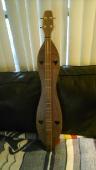
I'm bringing this thread up again as I just found it while doing a image google on quilt stands. I'm wanting to do another dulcimer stand and was looking through for quilt stand plans and pictures. Well, there my dulcimer was resting on one of the stands I pictured in this thread. I think I'm going in circles. I'll just use the measurements from my old stand and have my brother cut some wood for me.

How do I store them? Let me count the ways. Eight on a modified quilt stand. One on an X key board stand. And others scattered around the place on various wooden easel type of stands. 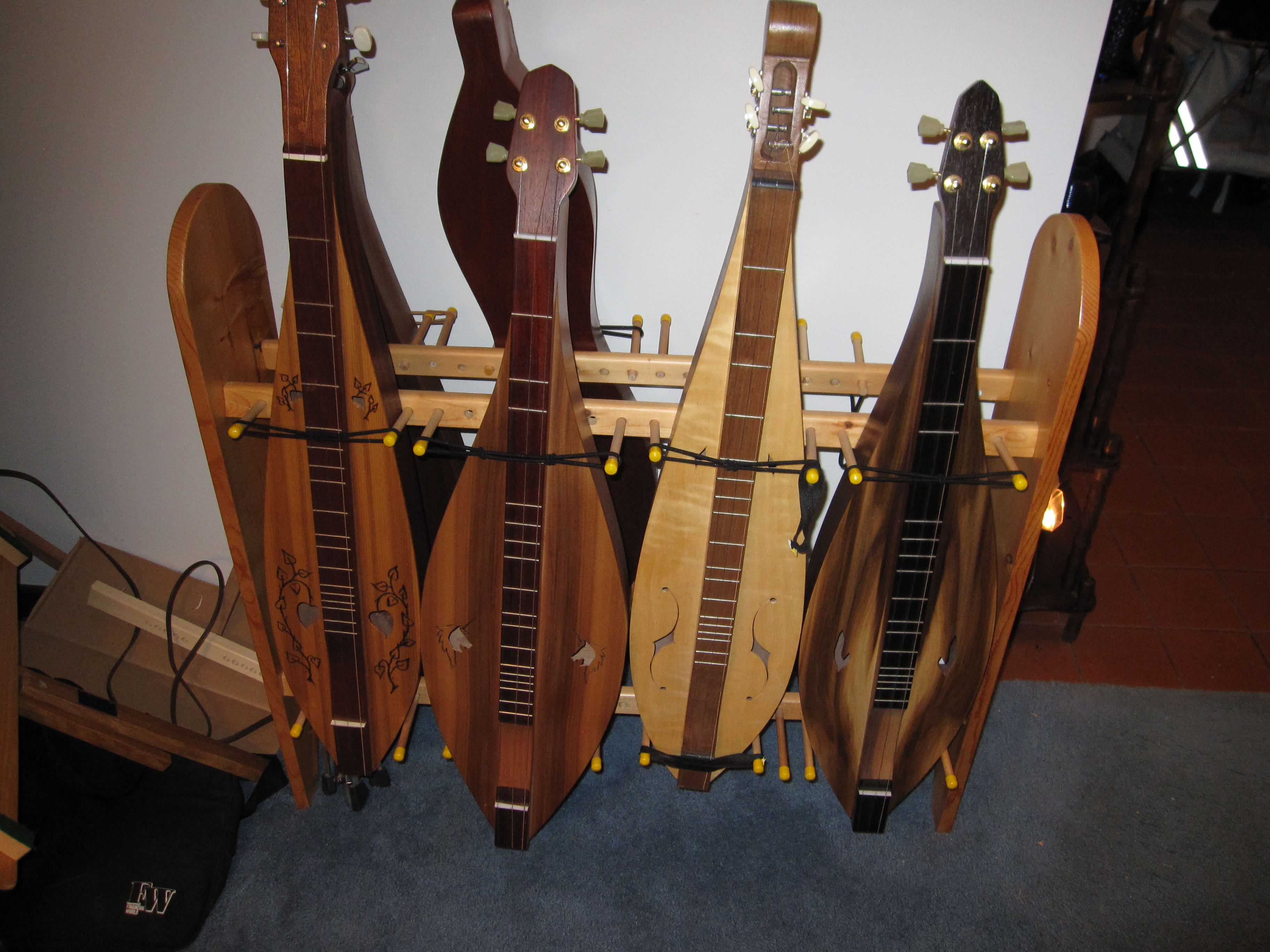
And they are usually covered with various small quilts I've made for dust covers as this one is on the keyboard stand.
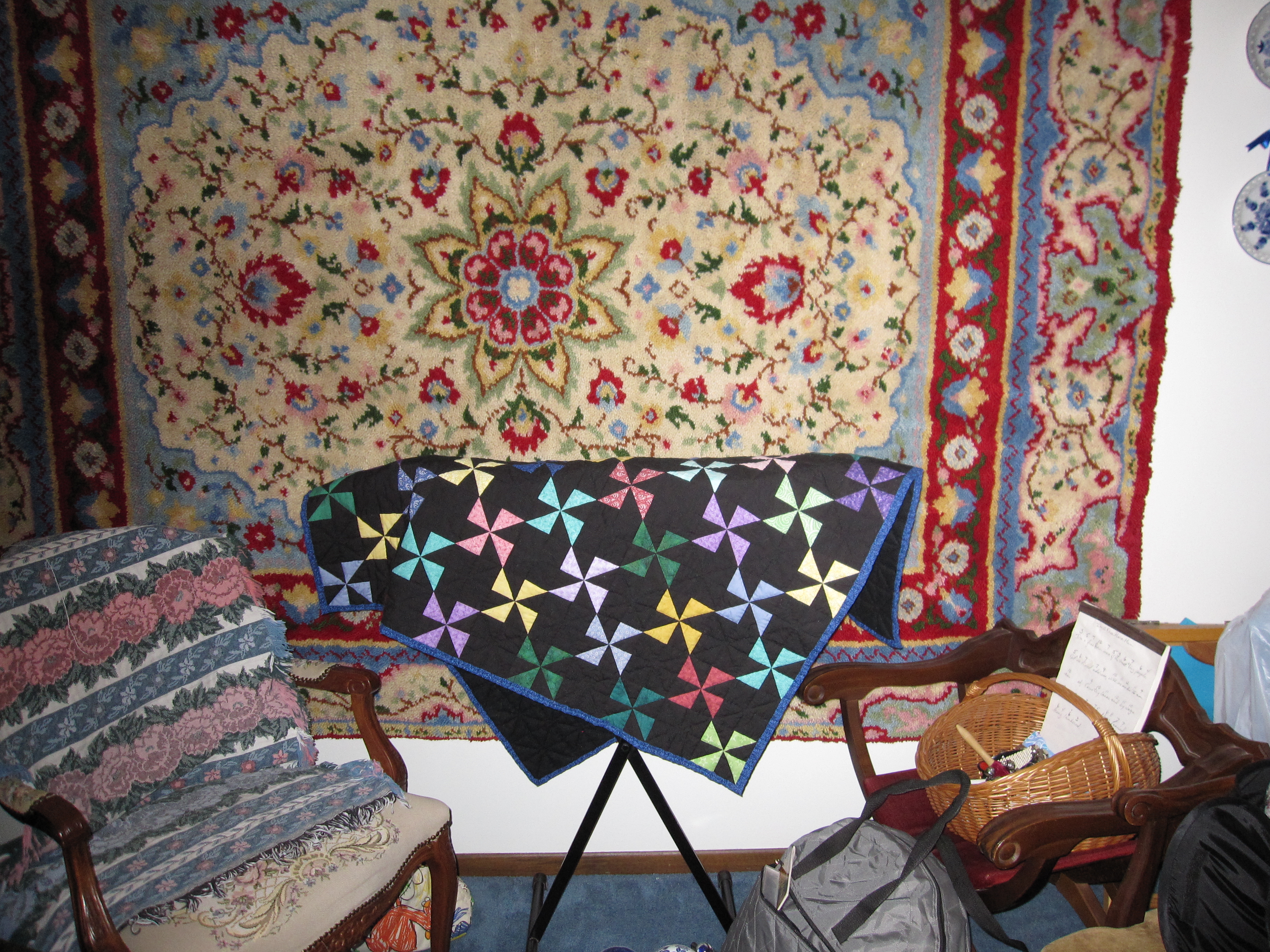 The keyboard stand is nice for standing up and playing. I don't have any hanging on the walls as I don't have much interior wall space with my home's floor plan.
And as to storing them in cases, well, I've never had a case for every instrument. Lee Felt's soft cases are the ones I have, two double and one single, but I wouldn't put instruments in them and leave them lying around on the floor. With my kultzy feet I'd end up stepping on them. 